'%3e%3cpath%20d='M422.855%200H315.186L331.103%2026.7375H346.784H374.482L321.817%20116.499L338.591%20144L422.855%200Z'%20fill='%233982F7'/%3e%3cpath%20d='M286.707%200H252.768L307.383%2093.1989L324.547%2063.7878L286.707%200Z'%20fill='%233982F7'/%3e%3cpath%20d='M422.855%200H315.186L331.103%2026.7375H346.784H374.482L321.817%20116.499L338.591%20144L422.855%200Z'%20stroke='%233982F7'/%3e%3cpath%20d='M286.707%200H252.768L307.383%2093.1989L324.547%2063.7878L286.707%200Z'%20stroke='%233982F7'/%3e%3cpath%20d='M28.4707%20108.591V44.9568H4.34668V32.5775H66.0694V44.9568H41.9454V108.591H28.4707ZM140.979%2098.3831C133.445%20106.057%20123.918%20109.894%20112.4%20109.894C100.881%20109.894%2091.3906%20106.093%2083.9289%2098.4917C76.4671%2090.8904%2072.7363%2081.5878%2072.7363%2070.5841C72.7363%2059.725%2076.5032%2050.4588%2084.0376%2042.785C91.5718%2035.1112%20101.098%2031.2744%20112.617%2031.2744C124.136%2031.2744%20133.626%2035.0751%20141.088%2042.6764C148.549%2050.2777%20152.28%2059.5803%20152.28%2070.5841C152.28%2081.4431%20148.513%2090.7093%20140.979%2098.3831ZM94.035%2089.8045C98.9611%2095.0168%20105.155%2097.623%20112.617%2097.623C120.079%2097.623%20126.2%2095.0168%20130.982%2089.8045C135.835%2084.5922%20138.262%2078.1854%20138.262%2070.5841C138.262%2063.0552%20135.799%2056.6845%20130.873%2051.4722C126.019%2046.1874%20119.861%2043.5451%20112.4%2043.5451C104.938%2043.5451%2098.7799%2046.1513%2093.9263%2051.3636C89.145%2056.5759%2086.7543%2062.9827%2086.7543%2070.5841C86.7543%2078.1129%2089.1811%2084.5197%2094.035%2089.8045ZM168.429%20108.591V32.5775H198.421C207.259%2032.5775%20214.286%2034.894%20219.502%2039.5273C224.718%2044.1605%20227.326%2050.3863%20227.326%2058.2048C227.326%2066.3852%20224.429%2072.7559%20218.633%2077.3166C212.91%2081.8774%20205.666%2084.1578%20196.9%2084.1578H181.795V108.591H168.429ZM181.795%2072.1043H197.334C202.333%2072.1043%20206.318%2070.8374%20209.288%2068.3037C212.258%2065.77%20213.743%2062.4398%20213.743%2058.3134C213.743%2053.9698%20212.258%2050.6396%20209.288%2048.3231C206.39%2045.9341%20202.406%2044.7396%20197.334%2044.7396H181.795V72.1043Z'%20fill='%23E2E8F0'/%3e%3cpath%20d='M457.019%20108.591V32.5775H470.385V108.591H457.019ZM526.065%20109.894C515.052%20109.894%20505.853%20106.129%20498.464%2098.6003C491.074%2090.999%20487.38%2081.6603%20487.38%2070.5841C487.38%2059.5803%20491.074%2050.2777%20498.464%2042.6764C505.853%2035.0751%20515.234%2031.2744%20526.608%2031.2744C533.199%2031.2744%20538.779%2032.2878%20543.343%2034.3149C547.978%2036.342%20552.324%2039.274%20556.383%2043.1107L547.798%2052.9924C540.988%2046.6942%20533.889%2043.5451%20526.5%2043.5451C519.254%2043.5451%20513.242%2046.1513%20508.461%2051.3636C503.75%2056.5759%20501.398%2062.9827%20501.398%2070.5841C501.398%2078.1129%20503.788%2084.5197%20508.57%2089.8045C513.351%2095.0168%20519.328%2097.623%20526.5%2097.623C530.846%2097.623%20534.685%2096.8268%20538.018%2095.234C541.349%2093.569%20544.791%2091.0715%20548.342%2087.7413L556.926%2096.4285C552.65%20100.917%20548.124%20104.283%20543.343%20106.527C538.562%20108.772%20532.802%20109.894%20526.065%20109.894ZM633.725%2098.3831C626.192%20106.057%20616.665%20109.894%20605.146%20109.894C593.627%20109.894%20584.138%20106.093%20576.675%2098.4917C569.213%2090.8904%20565.483%2081.5878%20565.483%2070.5841C565.483%2059.725%20569.25%2050.4588%20576.784%2042.785C584.317%2035.1112%20593.845%2031.2744%20605.363%2031.2744C616.882%2031.2744%20626.371%2035.0751%20633.834%2042.6764C641.296%2050.2777%20645.027%2059.5803%20645.027%2070.5841C645.027%2081.4431%20641.259%2090.7093%20633.725%2098.3831ZM586.781%2089.8045C591.707%2095.0168%20597.901%2097.623%20605.363%2097.623C612.826%2097.623%20618.947%2095.0168%20623.728%2089.8045C628.582%2084.5922%20631.009%2078.1854%20631.009%2070.5841C631.009%2063.0552%20628.545%2056.6845%20623.619%2051.4722C618.765%2046.1874%20612.608%2043.5451%20605.146%2043.5451C597.683%2043.5451%20591.527%2046.1513%20586.673%2051.3636C581.891%2056.5759%20579.501%2062.9827%20579.501%2070.5841C579.501%2078.1129%20581.927%2084.5197%20586.781%2089.8045Z'%20fill='%23E2E8F0'/%3e%3c/g%3e%3cdefs%3e%3cclipPath%20id='clip0_207_16'%3e%3crect%20width='652'%20height='144'%20fill='white'/%3e%3c/clipPath%3e%3c/defs%3e%3c/svg%3e)
Josh Kushner's Net Worth Hits $16.7 Billion, Up 3,200% in a Decade
Forbes pegs Josh Kushner's net worth at $16.7B, up from $500M in 2016 as Thrive Capital's AUM nearly tripled to $65B.
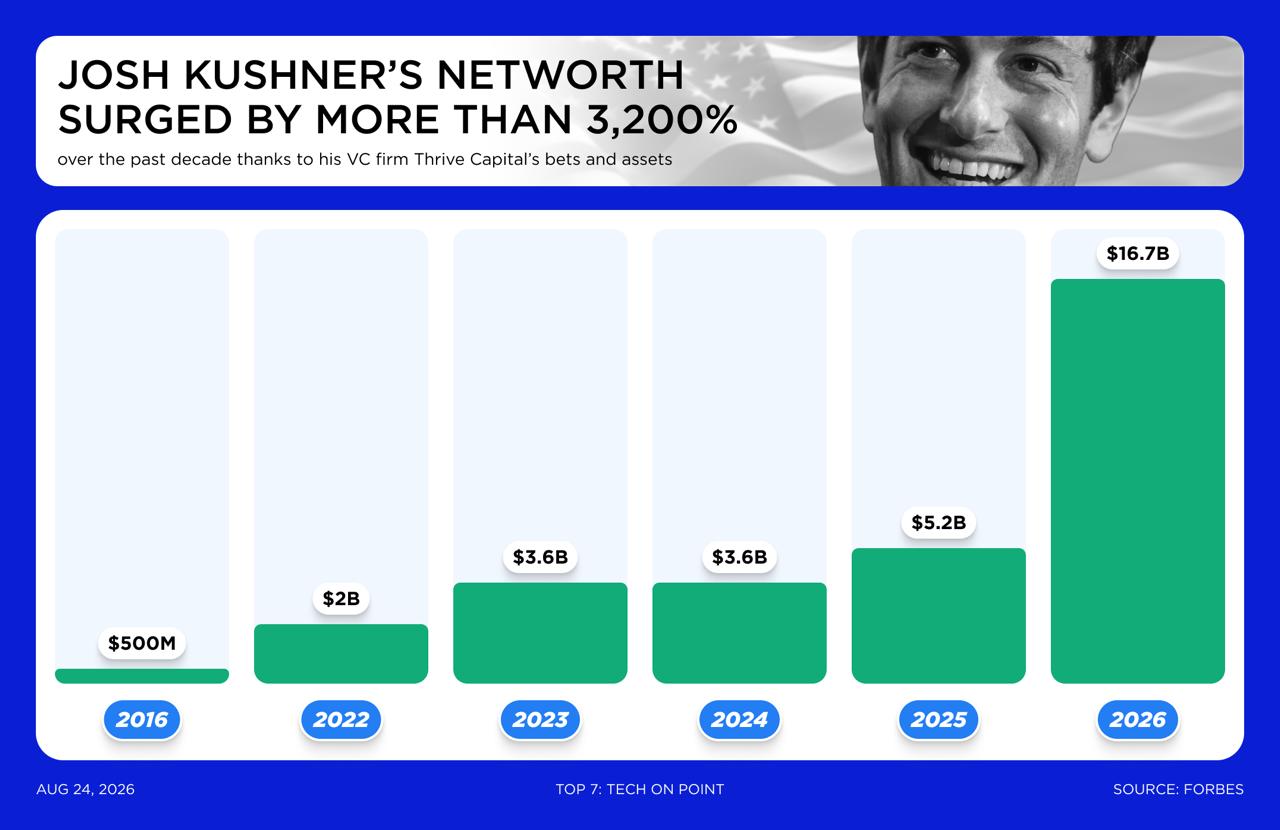
Forbes now values Josh Kushner at $16.7 billion, up from $500 million when it first measured his wealth in 2016 — a gain of more than 3,200% over the decade. Nearly all of that increase traces back to Thrive Capital, the venture firm he founded and owns about 66% of, whose assets under management nearly tripled from $23 billion in December 2024 to over $65 billion today.
Key takeaways
- Josh Kushner's net worth rose from $500 million in 2016 to $16.7 billion in 2026, a roughly 3,240% increase.
- His fortune nearly tripled in just twelve months, from $5.2 billion in 2025 to $16.7 billion in 2026.
- Thrive Capital's assets under management grew from $23 billion in December 2024 to over $65 billion now — a roughly 2.8x jump.
- Kushner told investors more than half of Thrive's AUM growth came from investment gains, not new capital raised.
- Thrive's funds have averaged 33% annual returns after fees, versus roughly 14% for the S&P 500 and 17% for the Nasdaq over a comparable period.
What does the full net worth timeline look like?
Forbes has tracked Josh Kushner's net worth at six points since 2016, and the pace of growth accelerates sharply toward the end of the series. The first nine years took his valuation from $500 million to $5.2 billion; the next twelve months alone added more than $11 billion on top of that.
| Year | Josh Kushner net worth |
|---|---|
| 2016 | $500M |
| 2022 | $2B |
| 2023 | $3.6B |
| 2024 | $3.6B |
| 2025 | $5.2B |
| 2026 | $16.7B |
The data shows two distinct phases. Between 2016 and 2022, Kushner's valuation quadrupled from $500 million to $2 billion. It then roughly doubled again by 2023 to $3.6 billion, where it held flat into 2024, before jumping to $5.2 billion in 2025 and more than tripling to $16.7 billion in 2026. The 2023-to-2024 plateau, followed by the 2025–2026 spike, suggests the bulk of Kushner's decade-long gain is concentrated in the most recent stretch rather than being spread evenly across ten years.
Why did Thrive Capital's assets under management nearly triple?
Thrive Capital's AUM grew from $23 billion in December 2024 to over $65 billion today, a roughly 2.8x increase in under two years. Kushner has said more than half of that growth came from investment gains on Thrive's existing portfolio rather than from raising new funds, meaning the firm's paper returns — not fresh limited-partner checks — did most of the heavy lifting.
That distinction matters for reading the headline AUM number. A fund that grows primarily through fresh fundraising is simply managing more outside capital; a fund that grows primarily through investment gains is compounding the value of bets it already made. Thrive's growth falling mostly into the second category is consistent with the sharp, concentrated jump in Kushner's personal net worth between 2025 and 2026, since his ownership stake rises in value alongside the fund's marked-up holdings rather than diluting as new investor money comes in.
How do Thrive's returns stack up against public markets?
Thrive Capital's funds have returned an average of 33% a year after fees, compared with roughly 14% for the S&P 500 and 17% for the Nasdaq over a comparable stretch. That means Thrive has nearly doubled the Nasdaq's annualized pace and more than doubled the S&P 500's, a gap that compounds dramatically over a multi-year holding period.
An annualized return is the average yearly gain a fund or index produces after fees, smoothing out volatility over the measurement period to make different investments comparable. At 33% a year, capital doubles roughly every 2.5 years; at 14%, the S&P 500's doubling time stretches closer to five years. Applied to Thrive's own AUM growth — from $23 billion to over $65 billion in under two years — that return profile is directly visible in the fund-level numbers, not just Kushner's personal valuation.
What does Kushner's 66% stake imply about Thrive's total value?
Kushner owns about 66% of Thrive Capital, and Forbes values that stake at $16.7 billion. Dividing his personal valuation by his ownership share implies the entire firm is worth roughly $25 billion, a figure derived purely from the post's own numbers rather than a separate Forbes estimate. That places Thrive's implied enterprise value at a level below the $65 billion it currently manages on behalf of clients, underscoring that AUM and firm equity value are two different metrics — a manager can oversee tens of billions in outside capital while its own ownership stakes are valued at a fraction of that sum.
For readers tracking how venture and hedge fund returns compare with other risk-adjusted strategies, the site's funding rate arbitrage and delta-neutral explainers cover analogous return-versus-benchmark comparisons in crypto derivatives markets. Broader coverage of protocol and fund performance metrics is available on the Top7 Markets research hub.
Bottom line
The numbers point to a single dominant driver: Thrive Capital's investment gains, not new fundraising or a decade of steady compounding, explain almost the entire jump in Josh Kushner's net worth. With AUM near $65 billion and returns averaging 33% a year after fees, the next data points to watch are whether Thrive's 2026 gains hold up in future valuations or whether, like the 2023-to-2024 plateau at $3.6 billion, growth pauses before the next reassessment.
Frequently Asked Questions
1.How much is Josh Kushner worth in 2026?
Forbes puts Josh Kushner's net worth at $16.7 billion in 2026. That is up from $500 million when Forbes first valued him in 2016, a gain of more than 3,200% over the decade.
2.Why did Josh Kushner's net worth triple in one year?
His fortune jumped from $5.2 billion in 2025 to $16.7 billion in 2026, roughly tripling in twelve months. The jump tracks Thrive Capital's assets under management nearly tripling from $23 billion in December 2024 to over $65 billion today, driven mostly by investment gains rather than new fundraising.
3.What is Thrive Capital's assets under management?
Thrive Capital now manages over $65 billion, up from $23 billion in December 2024. Kushner has told investors more than half of that increase came from investment gains on existing holdings rather than fresh capital raised from limited partners.
4.How do Thrive Capital's returns compare to the stock market?
Thrive's funds have averaged 33% annual returns after fees, according to the Forbes-sourced figures behind Kushner's valuation. That compares with roughly 14% for the S&P 500 and 17% for the Nasdaq over a comparable stretch, meaning Thrive has roughly doubled the Nasdaq's annualized pace.
5.How much of Thrive Capital does Josh Kushner own?
Josh Kushner owns about 66% of Thrive Capital, the venture firm he founded that underpins nearly all of his net worth. At a $16.7 billion valuation for that stake, the implied value of the entire firm works out to roughly $25 billion.
Sources
Forbes